
RESEARCH & EVIDENCE
What Happens When Students Learn With Interactive Teaching Assistants?
We're studying how interactive Teaching Assistants affect learning, engagement, student confidence, and the work of teachers, while following the broader research on conversational and pedagogical agents.
OUR CLASSROOM RESEARCH
Early Results From Clark County School District
5 schools109 studentsGrades 4–56 weeksFinancial literacy
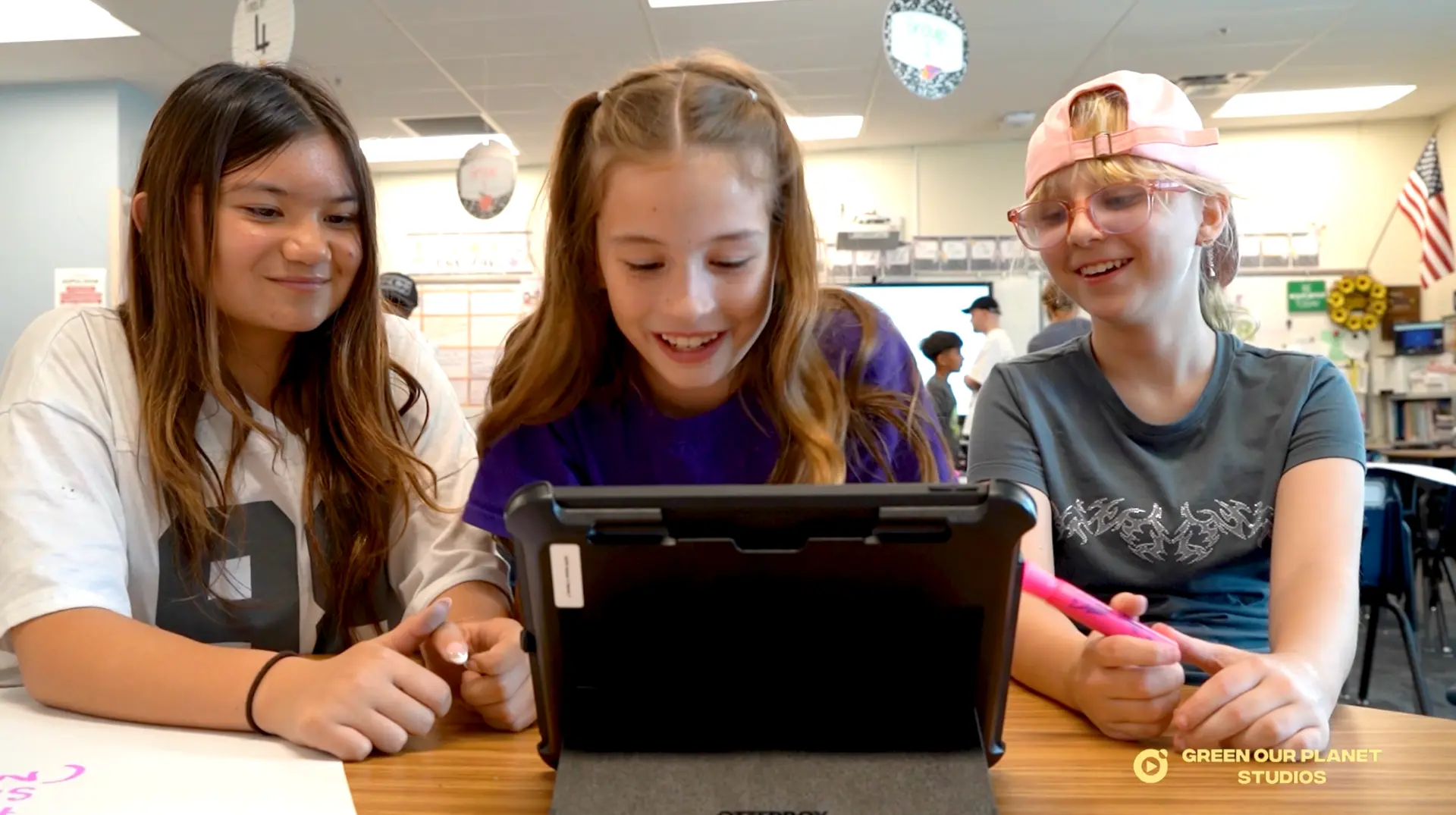
In spring 2026, Green Our Planet Studios and Green Our Planet worked with Clark County School District to study Quasar and Nova, interactive Teaching Assistants used alongside a financial literacy curriculum. The study examined student learning, engagement and interest, teacher experience, and classroom implementation. An independent evaluation was conducted by the Center for Innovation in Education.
+2.6 points
Students using Quasar and Nova scored approximately 2.6 points higher than the control group on an 18-point financial literacy assessment.
Statistically significant in the study analyses
80%
of students reported that using Quasar and Nova increased their interest in financial literacy.
82%
of students reported increased confidence in understanding the topic.
94%
of teachers reported that the Teaching Assistants made their jobs easier.
BEYOND THE NUMBERS
What We Learned
- 01
Learning Increased
Students using Quasar and Nova demonstrated substantially greater growth in financial literacy knowledge than students in the control condition in this study.
- 02
Engagement Mattered
Students reported better experiences when they approached Quasar and Nova with genuine curiosity or a specific need for help rather than simply because they were told to interact with them.
- 03
Personality Mattered
Positive outcomes were associated with interactions where Quasar and Nova behaved more like teachers or peers through humor, personalization, and relatable responses rather than feeling like computers or machines.
- 04
Teachers Valued Them Most When They Extended Their Reach
Teachers found the Teaching Assistants particularly useful when answering questions, providing enrichment, supporting students, and helping in situations where additional expertise or attention was valuable.
THE BROADER RESEARCH
We're Not Starting From Scratch.
Green Our Planet Studios' classroom studies are one part of a broader and growing body of research on educational agents, conversational learning, and technology-supported instruction.
The studies below are outside research. They did not study Green Our Planet Studios, Quasar, Nova, or our specific products.
OUTSIDE RESEARCH
Generative Conversational Agents and Learning
2026 Meta-analysis | 27 empirical studies
A meta-analysis found moderately positive effects of generative conversational agents on both cognitive and non-cognitive learning outcomes.
View Study (opens in a new tab)OUTSIDE RESEARCH
Educational Agents and Learning Outcomes
2026 Meta-analysis | 52 empirical studies
A meta-analysis found a significant positive overall effect of educational agents on learning outcomes, while also finding that effects varied across outcomes and contexts.
View Study (opens in a new tab)OUTSIDE RESEARCH
Pedagogical Agents in K–12 Education
2024 Systematic Review
A systematic review of pedagogical agents in K–12 education found that agent appearance and instructional role are interconnected, and emphasized designing agents around the pedagogical value they add.
View Study (opens in a new tab)WHAT COMES NEXT
Early Evidence. More Questions to Answer.
These early results are promising, but they are not the final word. The first study was relatively small, included only one control classroom, and focused on one subject and grade range. The independent evaluator recommended a larger next-stage study with stronger controls and enough participants to examine results across different students and classroom contexts.
That's what comes next.
As Green Our Planet Studios expands classroom implementations, we intend to keep studying what works, for whom, under what conditions, and how Teaching Assistants can best support teachers and students.
Building the Evidence Alongside the Technology.
As our Teaching Assistants evolve, so will the research behind them.